


How to Choose a Bike Light (Why Lumens Don’t Tell the Whole Story)
Most riders choose bike lights based on one number: lumens. But brightness alone doesn’t tell you how useful a light will feel on the road—or how visible you’ll actually be to drivers. This guide explains beam pattern, front vs rear strategy, flashing vs steady modes, and real-world usability so you can buy once and ride with confidence.
In the shop, we see a predictable cycle: a rider buys a “super bright” light, gets disappointed, and replaces it. Sometimes the light is bright but the beam is too narrow to be useful. Sometimes it’s bright but it blinds oncoming traffic, so the rider angles it down and loses coverage. Sometimes the battery life is fine on the box, but not in real life. And sometimes the rear light looks great from directly behind but disappears from an angle.

This article is not a night-riding safety guide. It’s a decision guide. The goal is to help you evaluate bike lights the way experienced riders and mechanics do: by matching the light’s job to your environment, beam pattern, mounting, and usability—not just a lumen number.
What bike lights are actually for
Bike lights do two different jobs, and confusing them is where most buying mistakes start.
- Seeing: A front light that helps you read the road surface, spot potholes, and stay relaxed when the lighting changes.
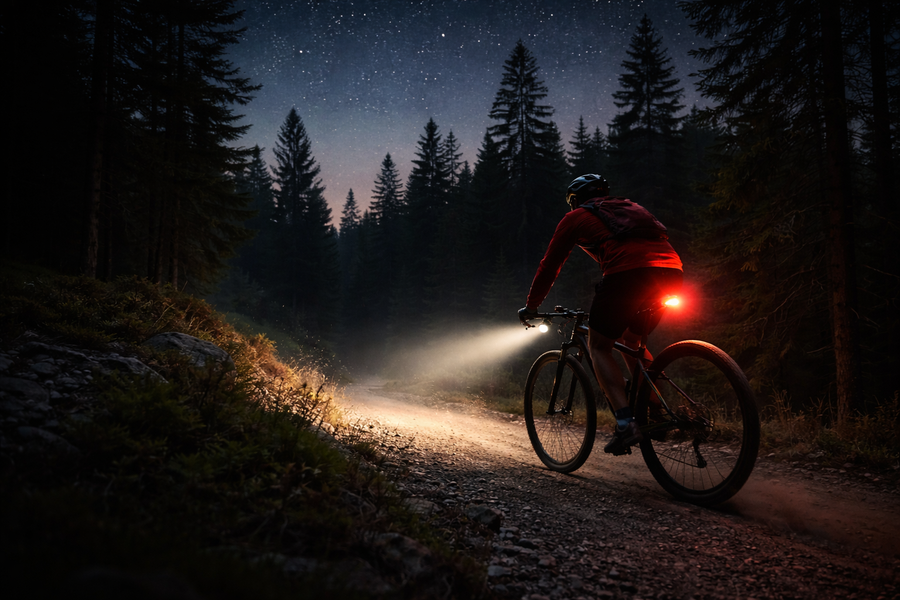
- Being seen: A rear light (and sometimes a front visibility mode) that communicates your presence to other road users from a variety of angles and distances.
Your environment determines which job matters more. In daylight traffic, you’re often trying to be noticed. In mixed lighting—trees, shadows, dusk—your front light may be more about consistency and contrast than raw brightness. And on unlit roads, beam pattern becomes the deciding factor because it determines what you can actually see and how comfortable you feel at speed.

If your primary goal is riding after dark, we have a separate, dedicated guide focused on night-specific setup and real-world night riding considerations here: Ride Safe After Dark: The No-Nonsense Bike Light Guide.
What lumens measure (and what they don’t)
Lumens describe the total amount of light a unit can emit. That’s helpful—but it’s incomplete. Two lights with the same lumen rating can feel completely different on the bike because what matters is where the light goes.
Here’s what lumens don’t tell you:
- Beam shape: A narrow beam can look impressive straight ahead but leave you blind to what’s happening in your periphery.
- Useful coverage: Some lights throw a hot spot and very little spill, which can feel “bright” but not “confidence-inspiring.”
- Glare control: A light can be bright and still be the wrong choice if it forces you to choose between seeing well and not blinding others.
- Real runtime: Battery claims are often tied to a low mode, not the mode riders actually use.
- Consistency across brands: Marketing standards and test methods vary. “Same lumens” does not guarantee “same experience.”

In practice, a lower-lumen light with a smart beam pattern and stable mounting can be more useful—and more comfortable—than a higher-lumen light that wastes output in the wrong places.
Brightness cheat sheet
Use this as context, not a rulebook. The goal is to match brightness to the job and environment, then prioritize beam pattern and usability.
Brightness Cheat Sheet (Quick Guidance)
| Riding context | Typical front lumen range | Beam priority | Key considerations |
|---|---|---|---|
| Daytime visibility (traffic, errands, commuting) | 200–500 | Wide, attention-getting | High-contrast modes, side visibility, simple controls, quick on/off |
| Urban mixed lighting (streetlights, shadows, dusk) | 400–800 | Wide with controlled hotspot | Glare control, stable mount, usable medium mode with real runtime |
| Low-light / unlit roads (brief reference) | 800–1500+ | Balanced throw + spill | Beam pattern and cutoff matter; avoid blinding oncoming road users |
| Gravel / trail use (where legal and appropriate) | 1000–2000+ | More throw with usable spill | Vibration resistance, long runtime, secure mount, easy mode switching |
Why beam pattern matters more than raw brightness
Beam pattern is the difference between a light that feels “bright” and a light that feels “useful.” Think of it as how the light paints the road in front of you.
- Wide beams help you see more of your environment and reduce the “tunnel vision” effect. They can make riding feel calmer and more predictable in mixed conditions.
- Focused beams push light farther down the road, which can help at higher speeds—but can also create a narrow, intense hotspot that leaves edges dark.
- Cutoff-style beams (when designed well) reduce glare by keeping light off the upper field where oncoming traffic and pedestrians are. This can improve comfort for everyone without sacrificing what you need to see.
Overly focused beams often cause the most disappointment. Riders crank brightness to “see more,” but the beam stays narrow. The result is a bright spot straight ahead, reduced peripheral awareness, and more eye fatigue. On the other extreme, an overly wide beam can waste output into the sky or into areas that don’t help you read the road surface.
A good beam pattern gives you a useful spread, consistent coverage, and enough distance to feel comfortable. The lumen number becomes secondary once the beam is doing the right job.
Front vs rear light strategy
Front and rear lights aren’t interchangeable. A strong setup treats them as a system.
Front light: seeing + signaling
- Primary job: help you read the road and maintain confidence as conditions change.
- Secondary job: make you noticeable in traffic (especially in daytime or mixed light).
- Practical tip: mounting stability matters. A light that slowly droops down or rotates on rough pavement turns a good light into a frustrating one.
Rear light: communication and presence
- Primary job: communicate your presence clearly from behind and at slight angles.
- What we see go wrong: rear lights mounted too low, blocked by bags, or aimed poorly so visibility drops off from the side.
- Practical tip: the most effective rear lights are easy to use consistently. If it’s a hassle to charge or mount, it won’t get used every ride.
For riders who want deeper night-specific guidance—beam placement, visibility habits, and real-world night riding constraints—use this dedicated reference: Ride Safe After Dark: The No-Nonsense Bike Light Guide.
Short answer: Do flashing lights help? Yes—sometimes. Flashing modes can grab attention in daytime traffic and busy urban environments. But steady modes are often better for predictability, especially in low light or group riding. The best approach is adaptable: use attention-getting modes when you need to be noticed, and steady modes when you want clear, consistent communication.
Battery life, mounting, and real-world usability

Many “good on paper” lights get replaced for one reason: they’re annoying in real life. The riders who are happiest with their lights aren’t the ones who bought the biggest number—they’re the ones who bought something that works with their routine.
- Battery life is mode-dependent. A light that claims long runtime may only deliver it on a low mode you won’t actually use.
- Charging friction matters. If charging is awkward or the port cover is fragile, you’ll eventually skip charging until the light is dead when you need it.
- Cold weather changes performance. Battery performance and usability can drop when it’s cold, especially if you rely on high-output modes.
- Mount stability is underrated. Rough pavement, gravel, and vibration can cause rotation, droop, and rattling. Stable mounts keep beam placement consistent.
- Controls should work with gloves. If the button is tiny or too sensitive, it becomes a daily frustration and riders stop using features that actually help.
When riders say, “This light is great but I replaced it,” it’s usually one of these: the mount slips, the runtime isn’t real, the beam pattern is wrong for their routes, or the charging routine is too annoying to maintain.
Fast setup checklist
- Front light: angled to illuminate the road without blasting other people in the eyes.
- Rear light: mounted where it’s visible from behind and slightly off-axis (not blocked by bags or clothing).
- The light stays fixed (no rotation or droop) on rough pavement or gravel.
- Battery life matches your typical ride length with margin.
- Controls are usable with gloves and cold hands.
- Lights are easy to remove when parking (to reduce theft and weather damage).
Why people buy the wrong bike lights
Most light disappointment isn’t because the product is “bad.” It’s because the purchase was made without a clear job description. Here are the most common mismatch patterns we see:
- Buying maximum brightness for urban riding. The light becomes uncomfortable for others, so the rider angles it down and loses useful coverage.
- Choosing a narrow hotspot beam. It looks bright in the driveway but feels stressful on real roads because peripheral visibility is poor.
- Ignoring side visibility on the rear. A rear light can be strong from directly behind but weak from an angle, which reduces real-world noticeability.
- Trusting battery claims without thinking about mode. Riders run high mode, get short runtime, and assume the light is defective.
- Buying one light to solve every scenario. A commuter needs different priorities than a rider spending long time on unlit roads. Buying for your primary scenario reduces regret.
The “buy once” approach is simple: pick the context you ride in most, prioritize beam pattern and usability, then choose the lumen range that supports that job. Once those fundamentals are right, the numbers matter far less.
Ready to compare lights based on how you ride?
If you want to browse options with this decision framework in mind—beam shape, front/rear strategy, and real-world usability—start here:
For night-specific guidance and setup habits, reference our dedicated night riding article: Ride Safe After Dark: The No-Nonsense Bike Light Guide.
FAQs
How many lumens do I actually need?
Start with your riding context. Daytime visibility and urban riding often benefit more from beam spread, visibility angles, and consistent usability than huge lumen numbers. If you regularly ride in darker, less-lit conditions, you may want more output—but beam pattern still matters more than raw brightness. Use lumens as a rough range, then choose based on beam shape and real runtime.
Can a bike light be too bright?
Yes. A light can be bright enough to cause glare for oncoming traffic or pedestrians, which can create safety issues and push you to aim the light poorly. A useful light is bright where it needs to be—on the road surface—without blasting light into other people’s eyes. Beam control and proper aiming matter as much as brightness.
Do I need different lights for day and night?
Not always, but many riders end up happier when their primary light matches their primary riding scenario. Daytime visibility can prioritize attention and wide visibility, while darker conditions prioritize controlled beam shape and real runtime. If you do both frequently, look for lights that have genuinely usable modes—not just a high mode and a weak mode.
Are flashing lights always better?
No. Flashing can be excellent for grabbing attention in daytime traffic, but steady modes are often better for predictability and comfort, especially in low light and group riding. The best setup gives you options and makes it easy to choose the right mode for the moment.
Why do some lights feel bright but still hard to ride with?
This is usually beam pattern. A narrow hotspot can look bright straight ahead while leaving the edges dark, which reduces peripheral awareness and increases stress. A better beam pattern provides useful spread, consistent coverage, and a comfortable balance between distance and spill—often at a lower lumen rating than you’d expect.
If you choose lights based on context, beam pattern, and usability, you’ll avoid most of the “buy twice” mistakes. Lumens matter, but they’re not the whole story. Get the fundamentals right, and your lights will feel better on every ride—without guesswork.
Leave a comment